
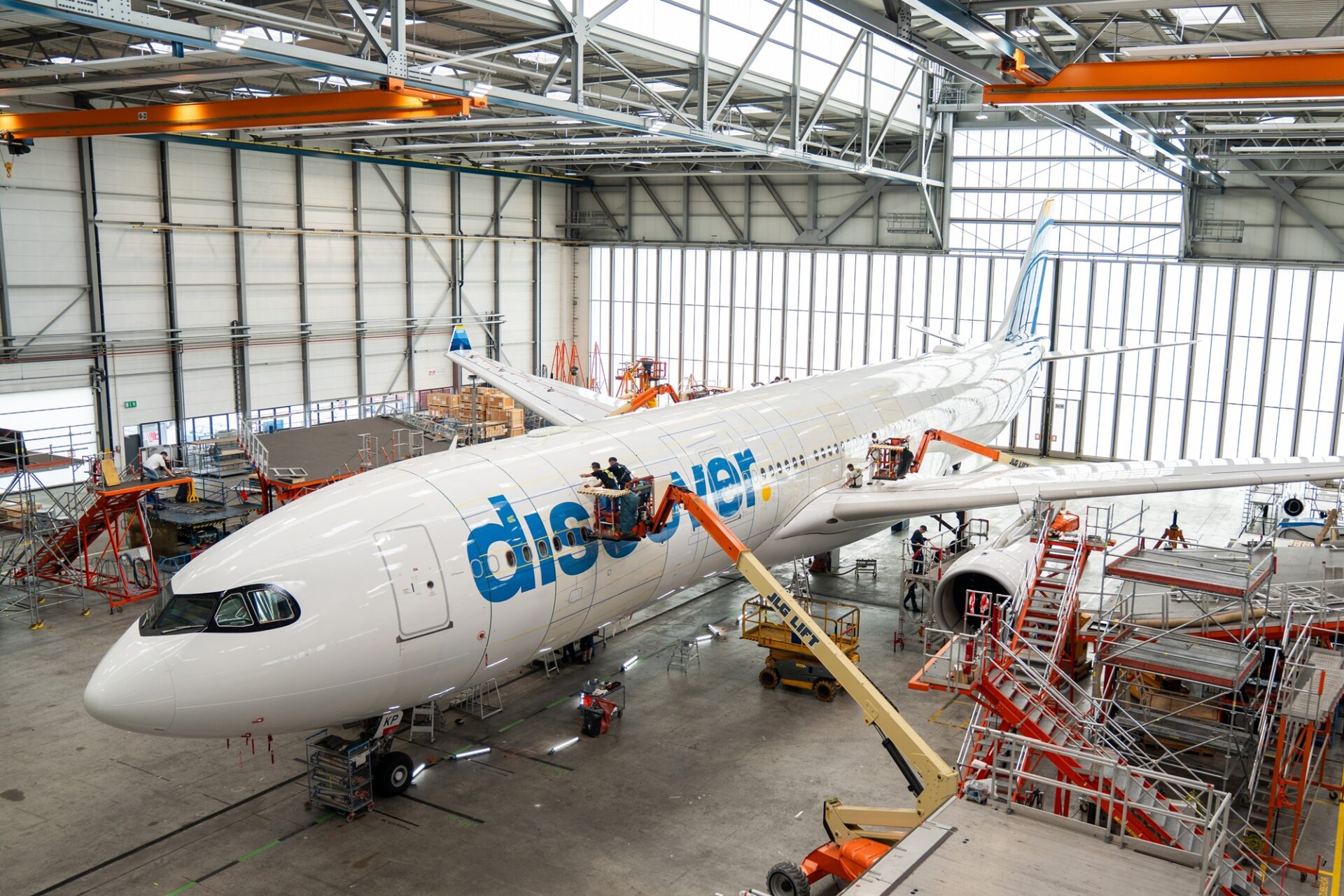
German maintenance, repair, and overhaul specialist Lufthansa Technik has entered the final certification phase to secure approval for modifying Airbus A330-200 and A330-300 aircraft with its AeroSHARK surface technology. The German company is seeking a Supplemental Type Certificate (STC) from the European Aviation Safety Agency (EASA), marking the expansion of the drag-reducing film onto its first Airbus widebody platform.
To support the final certification effort, a Discover Airlines Airbus A330-300 was selected as the initial test aircraft for the Airbus widebody family. The aircraft underwent surface modification at the Elbe Flugzeugwerke facility in Dresden before embarking on a series of ground and flight tests scheduled over several weeks. These test flights will generate comparative aerodynamic performance data before and after the modification to meet EASA regulatory requirements.
Developed in cooperation between Lufthansa Technik and BASF Coatings, AeroSHARK utilizes a thin, durable film structured with microscopic riblets that mirror the fluid dynamics of shark skin. On the Airbus A330ceo, the initial application covers key areas including the aircraft fuselage and engine nacelles. By optimizing airflow across these exposed surfaces during cruise flight, the technology is expected to reduce both fuel consumption and carbon dioxide emissions by around 1 percent.
Prior to targeting the Airbus A330 family, Lufthansa Technik secured regulatory approvals for Boeing 777 variants, including the 777-200ER, 777-300ER, and 777F freighters. As of August 2026, the Lufthansa Group had fitted AeroSHARK on 22 operational aircraft across commercial carriers including LATAM, SWISS, Lufthansa, All Nippon Airways, and EVA Air. Additionally, Lufthansa Technik reported in July 2026 that testing had commenced on an Airbus A319 (ICAO type code A319) flown by Lufthansa City Airlines.
