
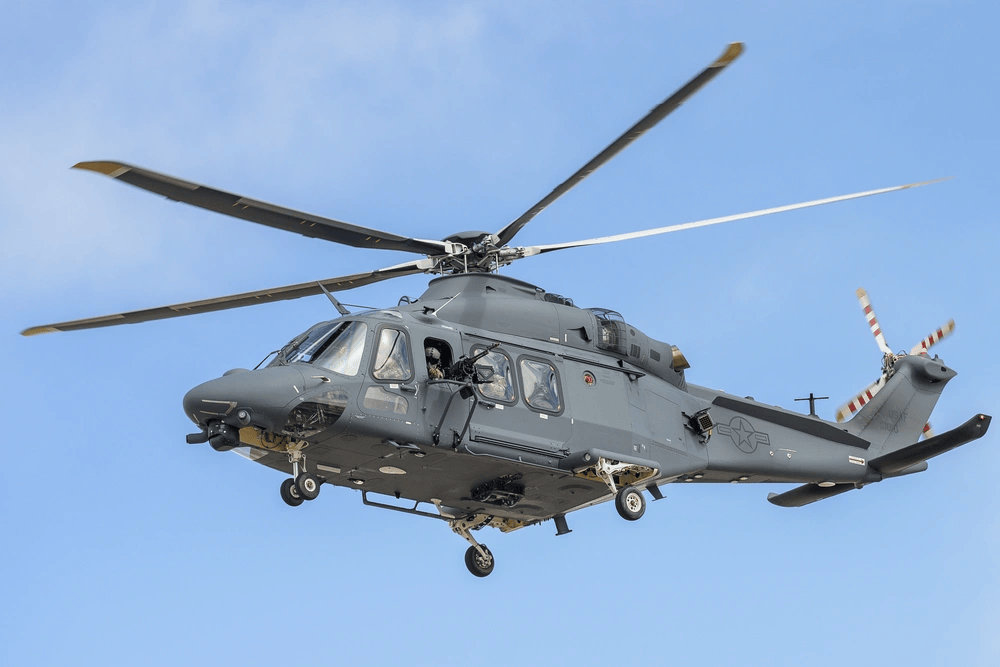
The Boeing MH-139A Grey Wolf helicopter achieved Initial Operational Capability (IOC) on 10 August 2026, marking the start of its operational replacement of the Vietnam-era UH-1N Huey in the US Air Force Global Strike Command’s nuclear security mission. The milestone signals a new era for airborne support of America’s land-based nuclear deterrent.
The MH-139A is derived from the commercial Leonardo AW139, modified by Boeing for military requirements. According to a USAF statement, the Grey Wolf is nearly 50% faster than the UH-1N, can carry twice as many troops, and incorporates enhanced defensive systems and a forward-looking infrared sensor, significantly improving speed, payload, and situational awareness across vast missile fields.
The operational need is driven by geography. At Malmstrom Air Force Base in Montana, for example, the missile complex covers approximately 13,800 square miles (35,740 square kilometres) and includes more than 100 launch facilities. The Grey Wolf’s combination of speed, range, and capacity is designed to meet the demands of patrolling and responding across such expansive terrain.
The type flew its first operational convoy in January 2026, when two aircraft from the 40th Helicopter Squadron escorted a Minuteman III maintenance and armoured security convoy to a launch facility more than 100 miles (160 kilometres) east of Malmstrom and back, completing the six-hour mission without refuelling. The sortie demonstrated the Grey Wolf’s endurance for long-distance convoy support.
Beyond convoy escort, the Grey Wolf is tasked with rapid emergency response and the recapture and recovery of launch facilities. USAF testing has examined scenarios covering convoy support, emergency response, and facility recapture, validating the helicopter’s ability to deploy tactical security forces quickly across difficult terrain.
