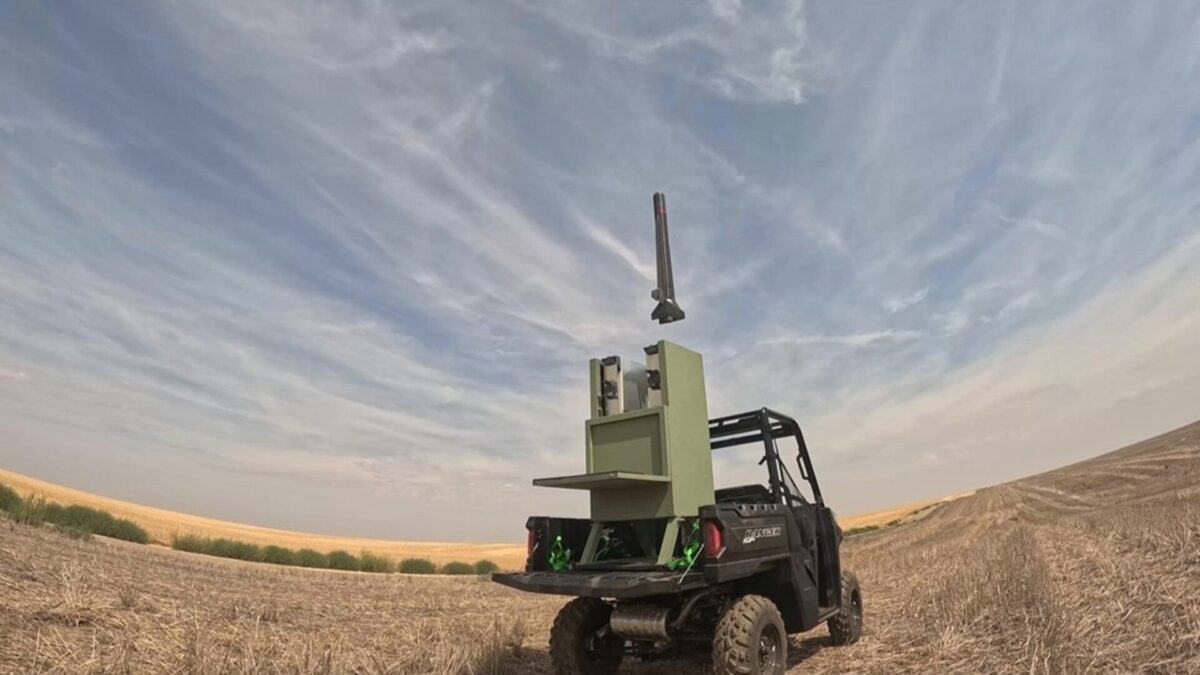
Cummings Aerospace announced on October 12, 2026, that it had demonstrated the simultaneous operation of two jet-powered Hellhound S3 attack drones using a single handheld controller. The company said the test took place on August 25, 2026, at the Pendleton UAS Range in Oregon, with the drones launched sequentially from a new launcher mounted on a Polaris utility vehicle.
According to the company, both drones carried inert payloads and flew different pre-programmed routes at different speeds, while a single operator monitored their flights. Before launch, a Cummings Aerospace engineer used the handheld fire control system to program waypoints, altitudes and flight paths for each Hellhound. Once airborne, the drones navigated their assigned routes autonomously, exchanging data with the controller. This allowed the operator to monitor both flights in real time and adjust or abort either mission if necessary. Cummings Aerospace did not describe direct coordination between the drones themselves.
Sheila Cummings, the company's CEO, said the approach would allow a single soldier to "simultaneously put multiple Hellhounds on multiple targets." "Controlling several S3s from one handheld system lets a small unit produce fires that used to take an entire battery," Cummings said. Cummings Aerospace said the demonstration met all its objectives.
The company said the test marked several firsts for the Hellhound S3, including its first vehicle-mounted launch, its first ripple-fire, or sequential launch, and the first time a single operator managed multiple Hellhounds through the same control system. It also marked the first use of a new launcher designed to carry up to eight Hellhounds. According to the company, the launcher is light enough to be lifted by two people and can be installed on different military vehicles. Previously, Hellhound had completed more than a dozen flights in its man-portable configuration.
The Hellhound S3 is a 3D-printed, turbojet-powered drone weighing approximately 6 kilograms (13 pounds). Cummings Aerospace describes it as a multi-mission weapon capable of serving as a loitering munition, precision-guided munition, one-way attack drone or counter-drone weapon. Its modular design allows operators to exchange four types of payload: armor-piercing, blast-fragmentation, electronic warfare, and decoy modules.
The company claims the S3 can reach speeds of around 618 kilometers per hour (384 miles per hour) and strike targets more than 60 kilometers (37 miles) away. It also says its manufacturing approach enables deliveries of more than 100 systems per month. The range claim is based on a previous flight test, during which an S3 flew more than 30 kilometers (19 miles) and landed with over half its fuel remaining. Cummings Aerospace extrapolated the potential maximum range from that result.
Cummings Aerospace said its next objectives include salvo-firing multiple Hellhound S3 drones from the new launcher and testing the system aboard unmanned ground and surface vehicles. In January 2025, the company said it intended to offer Hellhound for the US Army's Low Altitude Stalking and Strike Ordnance (LASSO) program. The US Army has since awarded LASSO prototype agreements to other manufacturers, including Textron Systems for its Damocles loitering munition in February 2026 and AeroVironment for its Switchblade 400 in May 2026.
