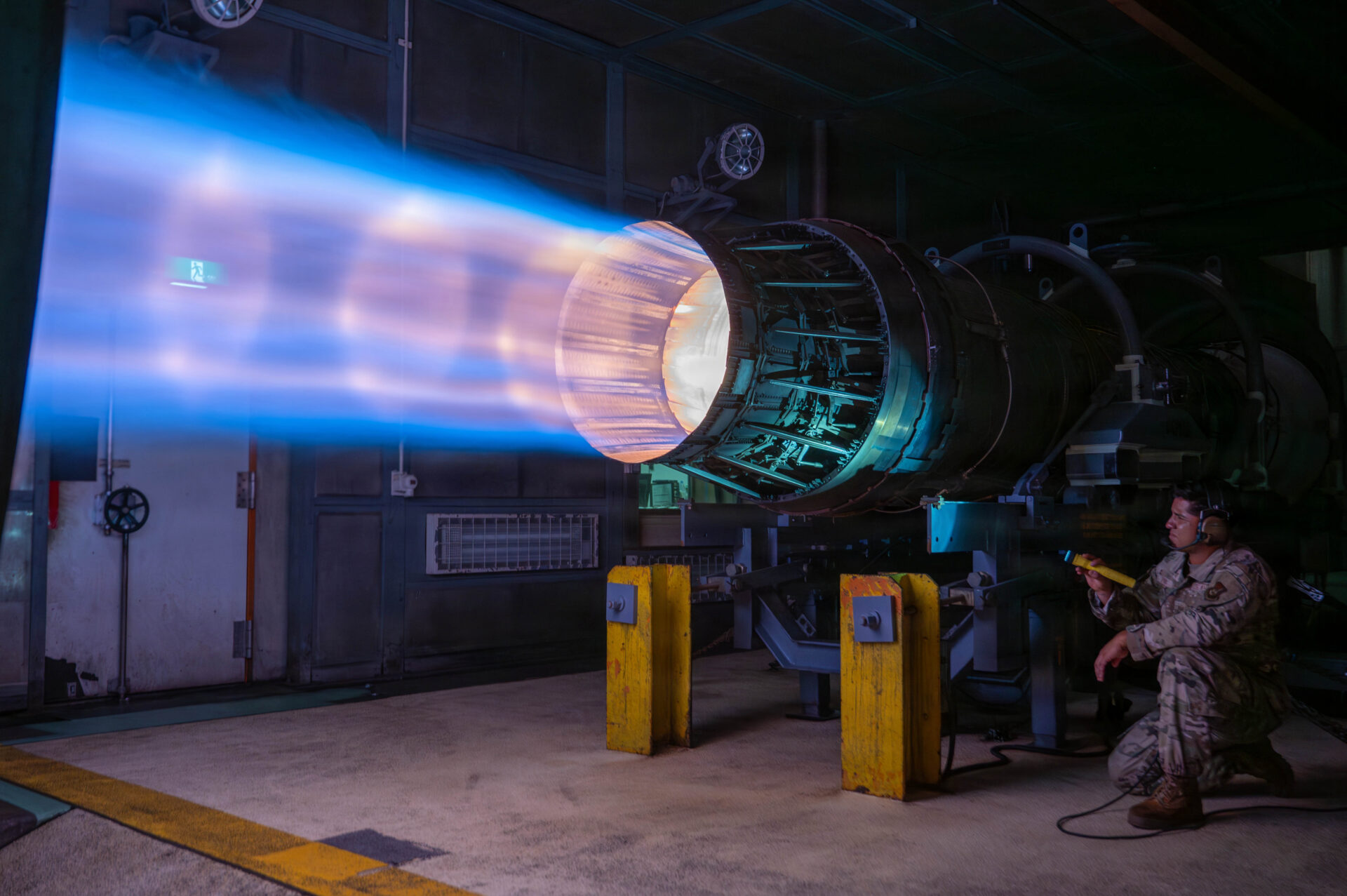
Aerospace startup Hermeus has signed a licensing agreement with RTX subsidiary Pratt & Whitney to manufacture F100-PW-229 fighter jet engines. Under the terms of the agreement, Hermeus obtains the right to assemble its own F100 engines to support the development and scaling of its hypersonic unmanned aircraft platforms.
The F100 engine series, produced by Pratt & Whitney, serves as the primary propulsion system for F-15 and F-16 fighter jets. Hermeus incorporates the F100 engine as part of the propulsion mechanism that will enable its Quarterhorse family of unmanned aircraft to reach high Mach speeds during testing and operational flights.
In addition to assembling standalone F100 engines, Hermeus is developing its proprietary "Chimera" propulsion system, which combines a precooled F100 engine with a ramjet. Because a ramjet features no moving parts and requires initial acceleration to generate thrust at high supersonic speeds, the precooled F100 engine provides the speed necessary before the ramjet can take over. The completed Chimera system is expected to power future iterations of the Quarterhorse aircraft.
Hermeus has previously flight-tested several prototypes in the series, including the Quarterhorse Mk 1 powered by a GE J85 jet engine, as well as the Quarterhorse Mk 2 and Mk 2.1 equipped with precooled F100 engines. On May 26, 2026, the Quarterhorse Mk 2.1 broke the sound barrier for the first time, achieving a speed of Mach 1.21 during a test flight over the White Sands Missile Range in New Mexico.
Hermeus Chief Executive Officer Zach Shore stated on September 15, 2026, that becoming a licensed manufacturer of the F100 expands domestic propulsion manufacturing capacity for the broader defense industrial base. Shore noted that the agreement positions Hermeus as one of the few vertically integrated airframers with the in-house propulsion capability required to scale the Quarterhorse program.
