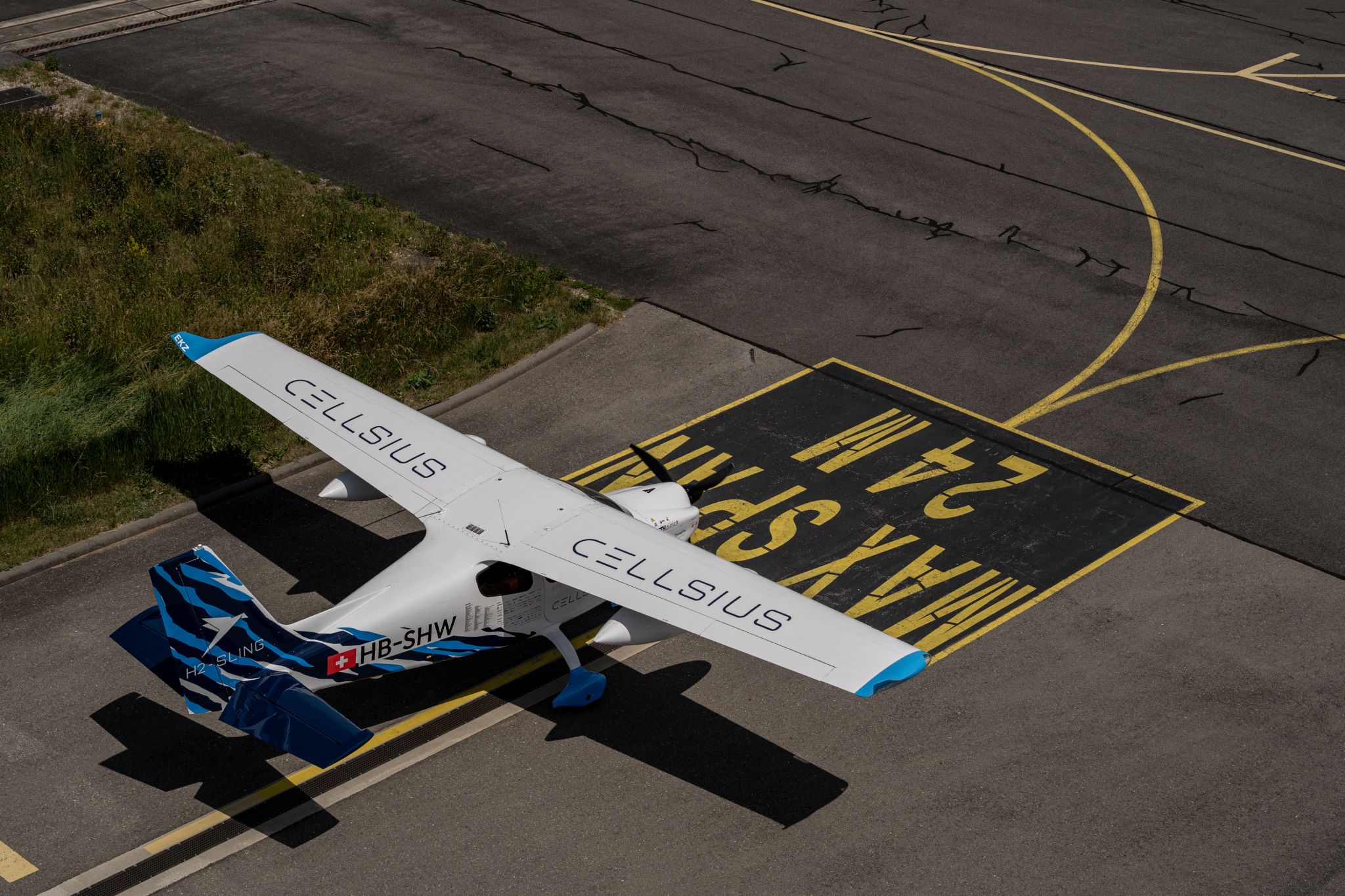
A Swiss student engineering team affiliated with ETH Zurich, CELLSIUS Aero, has transferred its H2-Sling hydrogen fuel-cell demonstrator aircraft from its construction site in Dübendorf to Payerne Airport (VIP) near Lausanne in Switzerland. The transfer marks the project's transition into the final stage of preparations before attempting to demonstrate the aircraft in actual flight at an active airfield.
The H2-Sling is built on a Sling High Wing airframe and uses a hydrogen-electric powertrain instead of a conventional internal combustion engine. The aircraft features a fuel-cell system rated at 100 kW, with maximum propulsion power listed by CELLSIUS at 105 kW following testing. The powertrain includes a 5.6 kWh battery buffer to manage short-duration changes in power demand, such as during takeoff. The aircraft's maximum takeoff weight is listed at 1,050 kg.
Hydrogen fuel is stored under a pressure of 700 bar across two high-pressure tanks located beneath the wings, providing a total storage capacity of 5.2 kg. The two-seat aircraft is designed to achieve a targeted flight range of 125 miles (200 km), approximately two hours of flight time, and a cruise speed of 100 mph (162 km/h). The technological setup mirrors concepts evaluated for larger hydrogen-electric aircraft by pairing sustained fuel-cell power with battery buffering.
CELLSIUS first unveiled the fully integrated H2-Sling in late 2025 and conducted ground tests throughout 2026 while working through legal and regulatory requirements. This new development follows the team's earlier e-Sling project, a battery-electric aircraft that first flew in 2022 with a range of 112 miles (180 km). Local media reports suggest the maiden flight could occur by the end of August, though ETH Zurich has not confirmed the timing.
