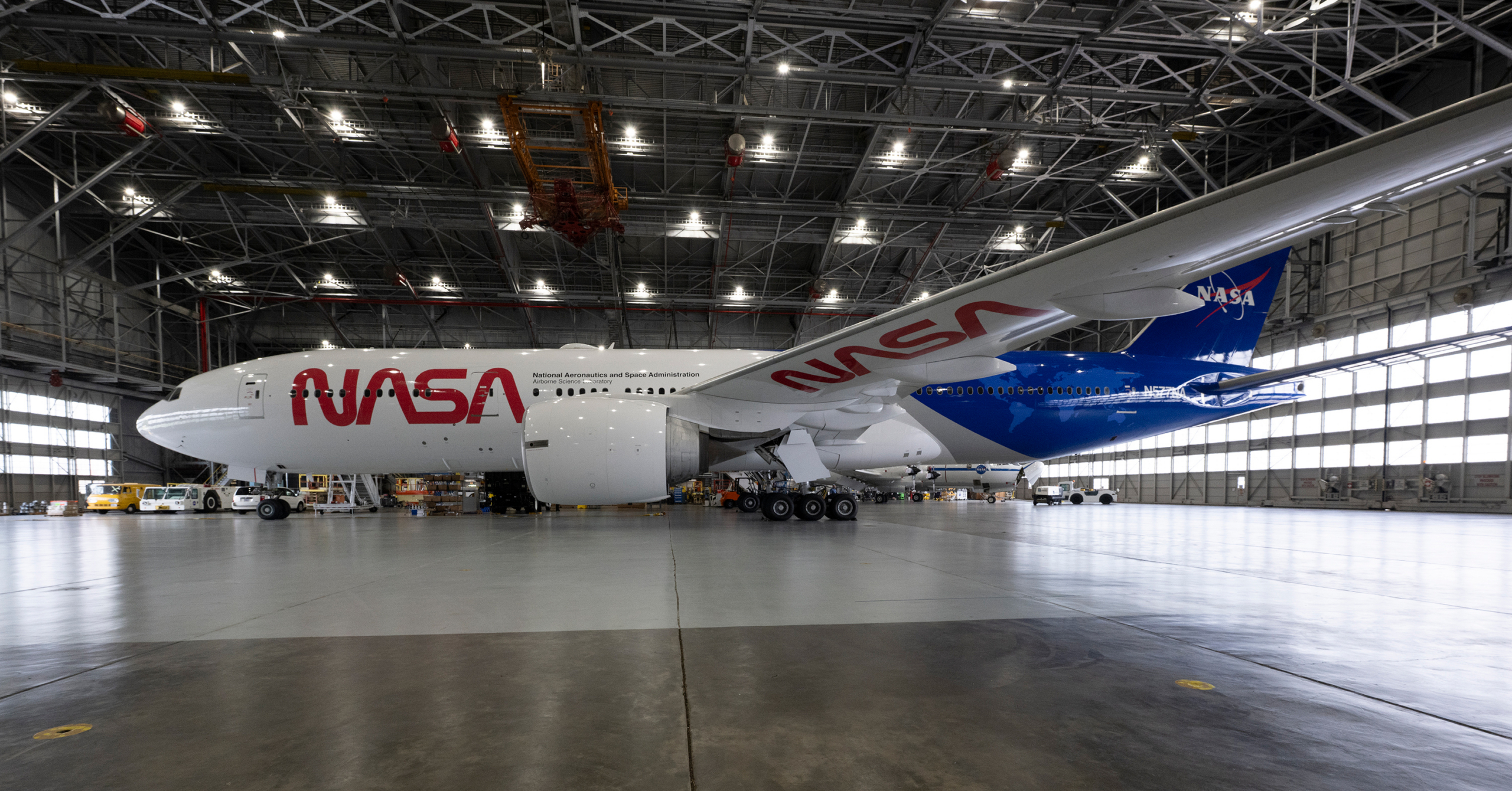
The National Aeronautics and Space Administration (NASA) has officially unveiled its newly acquired modified Boeing 777-200ER widebody jet, which will serve as the agency's new airborne research laboratory. Carrying registration N577NA, the aircraft was presented on August 12 showcasing a new NASA-themed livery before returning to the NASA Langley Research Centre in Virginia.
The new Boeing 777-200ER has been acquired to replace and expand upon the capabilities of NASA's previous Douglas DC-8-72 airborne laboratory, which was retired in 2024 after 37 years of service. During its operational history, the predecessor DC-8 supported atmospheric chemistry, meteorology, oceanography, volcanology, biology, and hydrology missions. The Boeing 777's extended range will provide global reach for future data collection projects.
Based at NASA's Langley Research Centre in Virginia, the aircraft will support various atmospheric projects for multiple United States government agencies, alongside environmental and aerospace research. Planned scientific missions include sensor development, satellite sensor calibration, data product validation, and field studies on Earth system processes to improve scientific models.
Originally manufactured in 2003 with serial number 32892, the Boeing 777-246(ER) was delivered to Japan Airlines and operated commercial flights under registration JA704J until its retirement in May 2020. The jet was later acquired by Southern California-based Logistic Air as N774LG before NASA selected the platform for its age, modern avionics, and long-range capabilities.
Extensive retrofitting began in 2025, conducted by L3Harris Technologies in Waco, Texas. Current modification work includes installing nadir and window instrument ports, enhanced power and communications systems, and specialized accommodations for instrument operators. NASA expects the aircraft to begin its initial scientific flight operations in early 2027.
