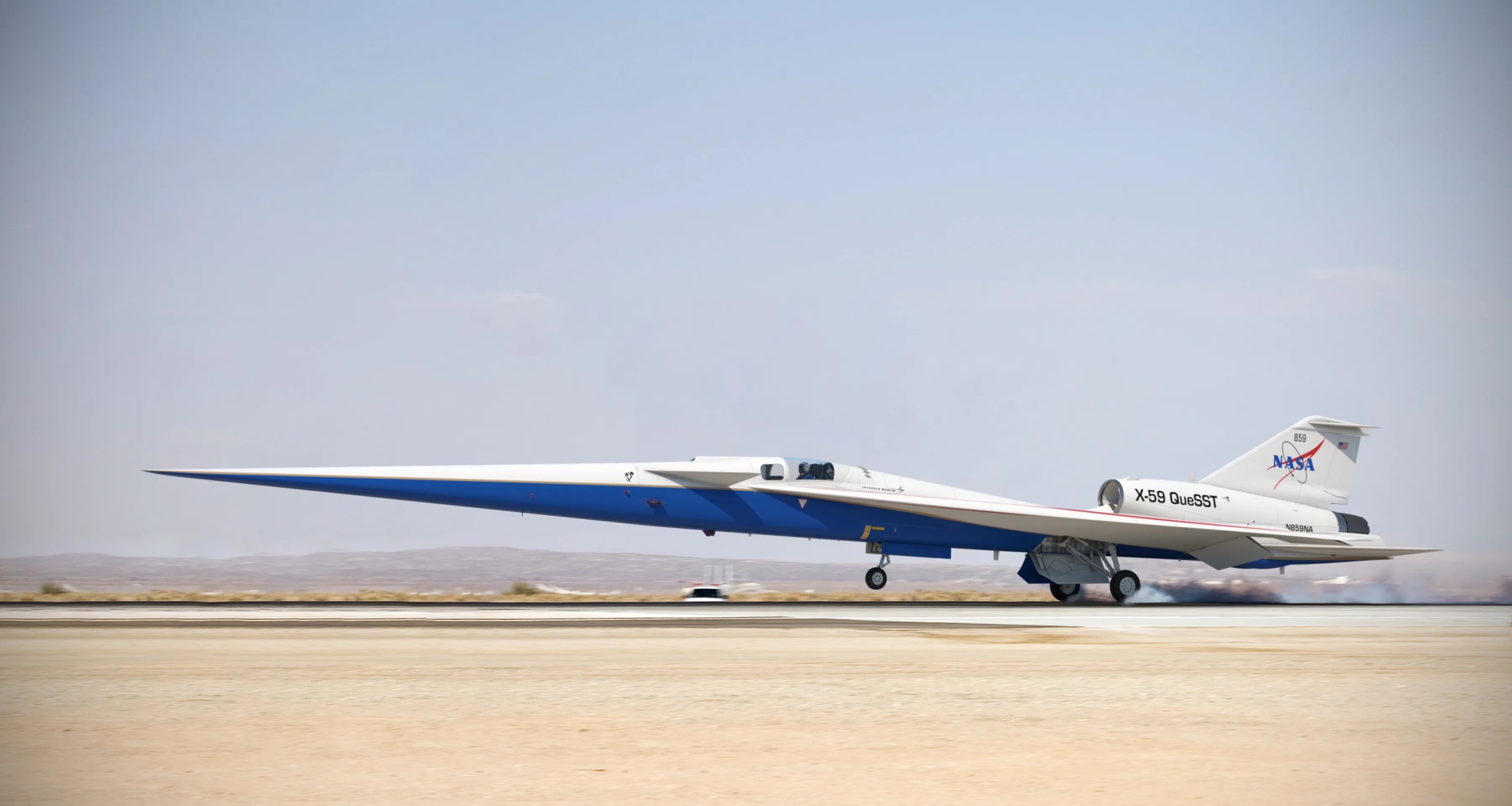
NASA released its 'X-59 Explainer: Science of Sonic Booms' on August 10, describing how pressure waves form around a supersonic aircraft, how they travel through the atmosphere and why they can combine to produce the loud boom heard on the ground.
The timing is notable because the X-59 has already achieved the speed and altitude NASA says it needs for future community flights, while the U.S. Federal Aviation Administration is developing a performance‑based, noise‑focused regulatory framework that could replace the longstanding ban on civil supersonic flight over land.
According to the article, the X-59 first exceeded Mach 1 on June 5, reaching approximately Mach 1.1 (713 mph) at 43,400 ft during an 81‑minute flight from Edwards Air Force Base in California, with test pilot Jim 'Clue' Less reporting the aircraft performed as expected.
A more significant milestone for the Quesst mission occurred on June 12, when the X-59 reached Mach 1.4, about 924 mph, at 55,000 ft for the first time. NASA calls these its 'mission conditions' because they approximate the speed and altitude at which the aircraft will eventually fly over communities to gather data on public response to its quieter sonic signature.
NASA stresses that reaching those conditions does not yet mean the X-59 has demonstrated the soft sonic thump it was designed to produce; the aircraft remains in flight testing and must complete performance testing before moving into the acoustic‑validation phase, where researchers will measure its supersonic acoustic signature and determine whether it performs as intended.
The explainer also clarifies a common misconception: a sonic boom is not a single sound at the moment an aircraft passes Mach 1, but a continuous system of pressure disturbances and shock waves that can merge into the strong pressure changes heard as the boom on the ground, with the perceived sound depending on aircraft shape, flight path and atmospheric conditions.
While NASA did not state the explainer was issued in response to the FAA’s rulemaking, both efforts address the same core challenge: enabling faster‑than‑sound flight without subjecting people on the ground to the conventional sonic boom.
