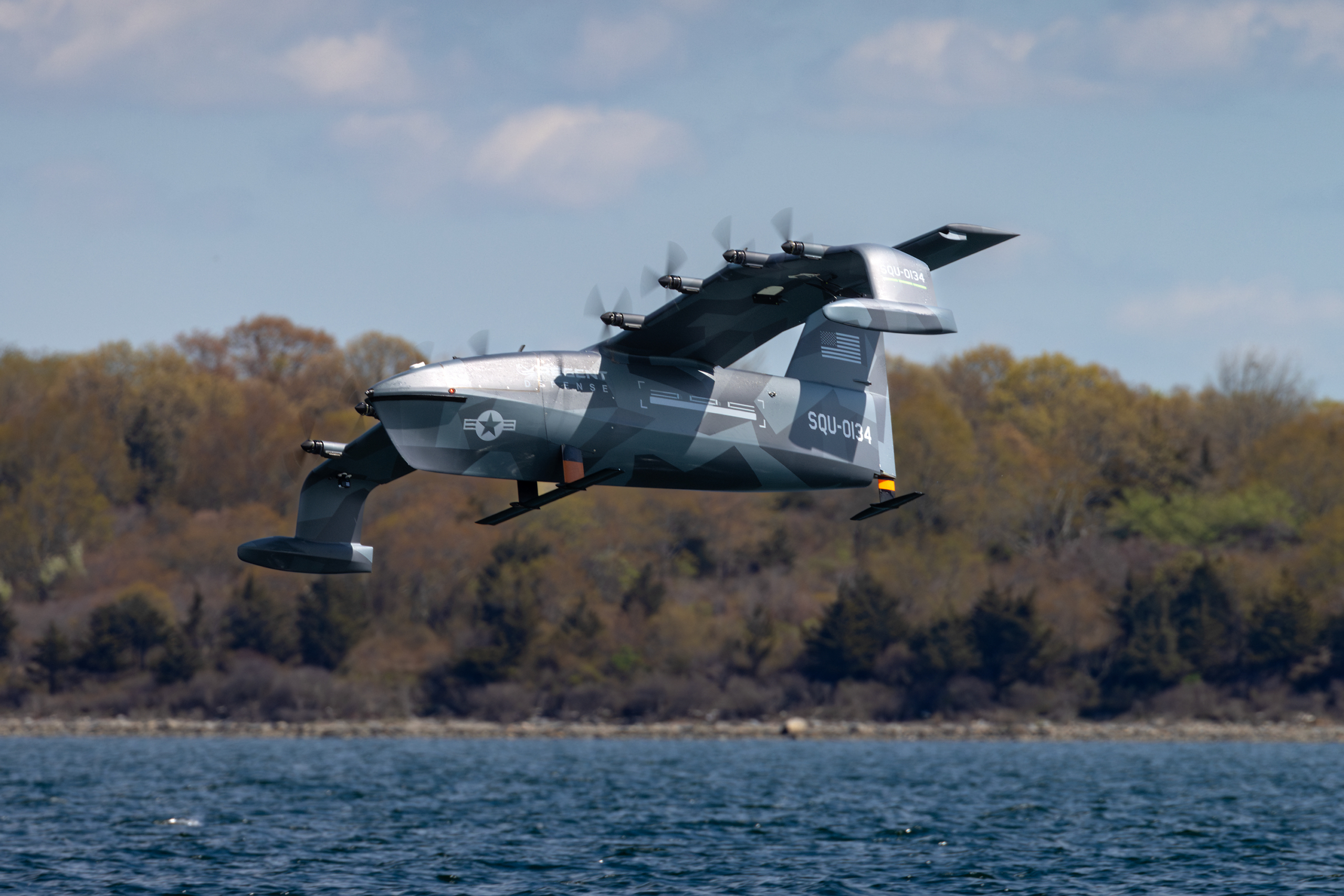
US-based manufacturer REGENT has completed operations with the US military using its autonomous Squire seaglider during the Silent Swarm military exercise held in Michigan. The two-week exercise brought together experimental uncrewed systems operating across land, air, and maritime domains, providing a platform to evaluate new autonomous technologies in operationally relevant settings.
During the Silent Swarm exercise, the autonomous Squire seaglider was equipped with operational payloads designed for electronic attack, electronic protection, and electronic warfare support. The vehicle operated alongside other uncrewed platforms while being exposed to various electromagnetic threats and countermeasures, including radar, communications, navigation, infrared, and directed-energy systems in contested environments.
Squire is a wing-in-ground vehicle, also referred to as a ground-effect vehicle, that utilizes an aerodynamic phenomenon to fly at extremely low altitudes just above the water's surface. Operating within roughly a wingspan of the water and below the radar horizon, the platform is designed to combine high speeds of up to 70 knots (130 km/h) with a low radar signature.
The Squire demonstrator is approximately one-quarter the size of REGENT's passenger-carrying Viceroy Seaglider and is designed to operate over distances of up to 100 nautical miles (185 km). According to REGENT, the Squire USA-V platform can carry payloads of up to 23 kg (50 lb) to support missions such as intelligence, surveillance, and reconnaissance, frontline logistics, search and rescue, and anti-submarine warfare.
To expand its presence in defence applications beyond commercial passenger transport, REGENT established a dedicated defence division in July 2025 to market the autonomous vehicle to military and civil defence operators. The company is also working on flight-control software for autonomous operations and developing a militarised hybrid variant of its larger Viceroy platform.
