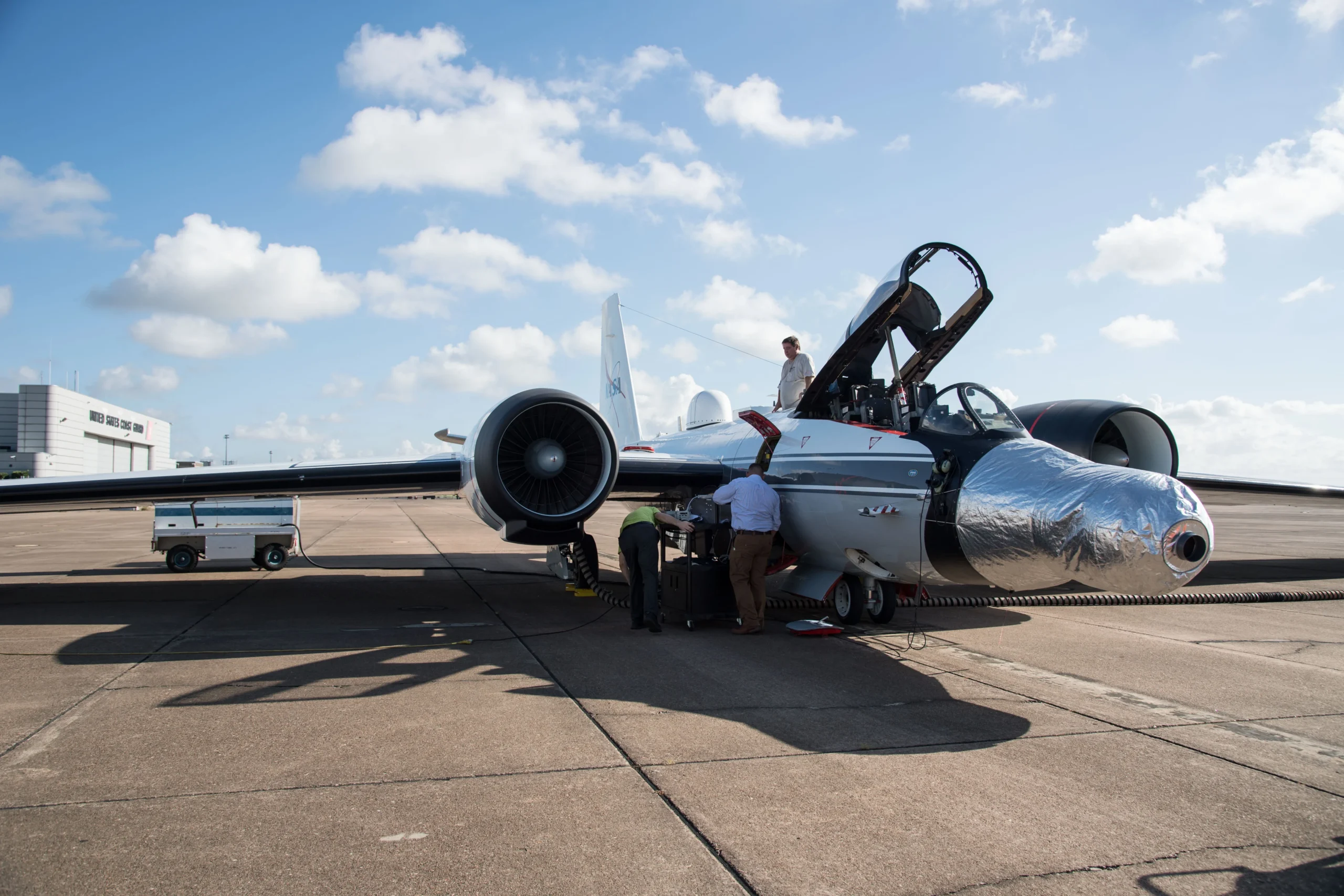
NASA plans to deploy one of its WB-57 high-altitude research aircraft into the path of the total solar eclipse scheduled for August 12, 2026, operating at an altitude of approximately 50,000 feet. As the Moon’s shadow travels across regions including Greenland, Iceland, and Spain, the aircraft—a specialized variant of the Cold War-era English Electric Canberra design—will carry airborne imaging equipment to capture views of the Sun that scientists cannot easily acquire from ground observatories or space platforms.
Mounted directly in the nose section of the WB-57 will be the SCIFLI Multispectral Airborne Imager, known as SAMI, which was developed by NASA’s Scientifically Calibrated In-Flight Imagery team at the Langley Research Centre. The specialized instrument combines four separate cameras designed to record high-resolution images across multiple wavelengths of visible and infrared light. According to project plans, the imaging system will capture at least 20 frames per second during totality to detail the dynamic structures, outflows, and rapid changes occurring within the Sun’s corona.
Flying at 50,000 feet offers substantial operational advantages, placing the research aircraft well above cloud layers and above lower atmospheric layers that absorb specific infrared wavelengths. Additionally, by traveling along the eclipse path at roughly 460 mph, the WB-57 will keep its scientific instruments within the shadow for nearly three minutes. This extended airborne viewing window surpasses the maximum ground-based totality duration of two minutes and 18 seconds, enabling the collection of hundreds of extra scientific images.
Alongside the WB-57 research flight, NASA-funded research teams will launch dozens of scientific balloons from locations in Iceland and Spain to measure how Earth’s atmosphere responds when daylight is rapidly interrupted. The combined datasets will be used by researchers to investigate solar prominences, examine why the solar corona reaches extreme temperatures, and better understand the mechanisms driving the solar wind throughout the solar system.
